SEO News Roundup – January 2026
It’s the start of the new year, and we’re seeing key developments in the SEO landscape. Whether you’re team AI or not, what’s clear is a further push towards AI integration… And no, you may be feeling the Jan’ blues, but that doesn’t mean traditional SEO is “dead.”
Below, we’ve rounded up the January SEO news and stories from this month that have caught our attention, and we’ll explain why they should be on your radar too.
January Algorithm Updates: the Aftermath of Google’s December Core Update
Google’s December core update rollout began on 11th December and completed 18 days later on 29th December, 2025. Now, in January, we’re finally settling into the changes and seeing the results.
In usual fashion, Google stressed that the rollout was focused on refining overall search relevancy, without any particular specifics.
This is a regular update designed to better surface relevant, satisfying content for searchers from all types of sites. – Google Search Central
However, the update appears to further reflect Google’s continued efforts to tackle low-quality, keyword-stuffed content and bring trustworthy, original content to the top.
Real lived experience is now a stronger ranking factor than ever, among other factors built around E-E-A-T. Think regular updates, clear author profiles, transparent policies, and authoritative citations that actually lead somewhere (take that, ChatGPT).
It’s no surprise, then, that we’ve continued to observe a pattern of specialised sites outperforming those more generalised. This is particularly the case in the health and finance sectors, aka YMYL content that, when inaccurate, can potentially cause real-world harm. In short: the stuff where trust matters most.
The December broad core update impacted YMYL sites heavily (and early). I saw massive volatility right away with many sites focused on finance… And not far behind finance was the health and medical niche. That vertical also saw massive volatility and across some of the top health and medical sites on the web. – Glenn Gabe, CEO of G-Squared Interactive
News publishers across the globe have also taken a hefty beating, with several seeing declines in search visibility.
Beyond the health and medical volatility, I’m seeing a number of news publishers with heavy impact… Some news and media publishers have been nuked from Discover with this update. – Glenn Gabe
This trend is feared to continue, with an anticipated fall of 43% within the next three years. We’ll have more to say on whether this fear aligns with reality soon, though.
Google Unveils Universal Commerce Protocol (UCP) for AI E-Commerce
Google announced the release of UCP on 11th January, an open-source standard for agentic commerce created with one key goal in mind: To enable consumers to shop for products directly through Google’s AI-powered interfaces without having to visit the actual store page.
The Universal Commerce Protocol (UCP) is an open standard designed for the future of commerce, empowering you to turn AI interactions into instant sales. Adopt UCP to enable agentic actions on Google AI Mode and Gemini, starting with direct buying. – Google
This may change how customers discover, compare, and buy products online… And, more crucially, how we maintain customer relationships and tackle e-commerce SEO.
Our goal is to build a future of retail where the opportunity space expands for everyone. One where customers can use Google products they love as part of a seamless shopping experience. – Sundar Pichai, CEO of Google
However, this doesn’t mean it’s going to decimate traffic overnight. Distrust of AI remains at a high, and with the alarming prevalence of AI online shopping scams, people are still likely to take research into their own hands (and click their way to your site). Even Google’s John Mueller remains unconvinced that the UCP will kill off the need for traditional SEO.
AI continues to be pushed by Google and businesses across the globe, but will it ever truly gain momentum? The data currently says no.
Google AI Overviews Follow-Up Questions Go Straight to AI Mode
Back in December, we learnt that Gemini 3 Flash was rolling out globally in Google Search. There have since been more major developments. Google AI Overviews are now being powered by Gemini 3 globally:
We’re making Gemini 3 the new default model for AI Overviews globally, so you get a best-in-class AI response right on the search results page, for questions where it’s helpful. – Robby Stein, VP of product for Google Search
What’s more, Google will now go directly to AI Mode when you do a follow-up question from AI Overviews. Once you hit the “Show More” button on an AI Overview, an “Ask anything” chat box will pop up at the bottom and allow you to ask more questions about your initial query. The aim is to save the searcher time and better capture the flow of a natural conversation (i.e., an attempt to get AI to “parrot” human chatter).
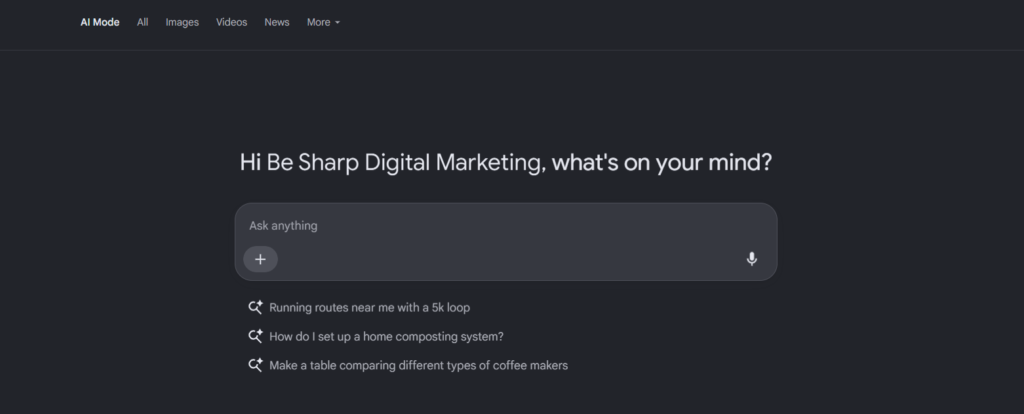
We’re making the transition to a conversation even more seamless. Now, you can easily ask a follow-up question right from an AI Overview, and jump into a conversational back and forth with AI Mode. In our testing, we’ve found that people prefer an experience that flows naturally into a conversation — and that asking follow-up questions while keeping the context from AI Overviews makes Search more helpful. – Robby Stein
From an SEO perspective, we’re again seeing a push for AI-powered interactions within Google Search. And with the new follow-up approach, getting click-throughs may become trickier…
Still, from prior data insights, the impact likely won’t be dramatic as headlines may lead you to think. 2025 introduced several AI integrations. However, organic search traffic was only down a modest 2.5% in 2025 rather than a dramatic drop like some had anticipated.
Users appear to still prioritise brands’ own websites for authenticity
and depth. Perhaps out of fear of AI hallucinations, or perhaps simply because many feel human connection and experience tops all else.
Plus, with the new Competition and Markets Authority (CMA) proposed measures for Google Search in the works, and Google’s own admission that they’re exploring ways to allow sites to opt out of search AI features like AI overviews?
We’re now exploring updates to our controls to let sites specifically opt out of Search generative AI features. Our goal is to protect the helpfulness of Search for people who want information quickly, while also giving websites the right tools to manage their content. We look forward to engaging in the CMA’s process and will continue discussions with website owners and other stakeholders on this topic. – Ron Eden, Principal, Product Management at Google
We’re not quite convinced that this is going to be an “SEO-killing” development, or herald the SEO apocalypse, anytime soon. As ever, an efficient SEO strategy as part of wider digital marketing efforts remains the most effective solution for organic search, which includes GEO. We’ll keep you posted about this and have more to say in future updates.
Even with anonymised data, when location data and sensitive/personal matters are combined, it can reveal the identity of a user.
In overseeing the process, Mehta has set up a five-person technical committee. This team will decide which firms will be authorised access, as well as how the data will be shared and the necessary safeguards to put in place.
The committee is in place for six years and includes specialists in the related fields of data security and AI. The experts are in, but doubts linger over the committee’s ability to both protect privacy and encourage fair competition.
The Sharp Opinion
Reacting to this month’s news, the head of B# had the following comments:

This latest core update is an effective step forwards for the search engine giant as it battles against the tide of AI spam that is being thrown its way. It is important to take this moment to stress the importance of using human-written, well-researched, and quality-focused content across public URLs. Those falling into the trap of using AI content to save time or resources will harm themselves in the short-term, and simply create additional long-term costs. The fundamentals of SEO remain the same – as they have for well over a decade. – Jonny Crossley, Founder & CEO of Be Sharp Digital Marketing
That’s all for our January SEO news! Our New Year’s resolution is to keep you updated each month, so stay tuned.